How Many Rooms Should You Virtually Stage? (And Which Ones Matter Most)
You've decided to virtually stage your listing: a smart move that puts you ahead of sellers who think empty photos are "good enough." But now comes the strategic question that impacts both your budget and your results: how many rooms should you stage, and which ones deserve the investment?
The answer isn't one-size-fits-all. A 1,200 sq ft condo requires a different approach than a 4,500 sq ft family home. Your budget, timeline, competition, and property type all influence the optimal staging strategy. Let's break down the decision-making framework that maximizes buyer impact while respecting your investment constraints.
The Short Answer: Stage What Buyers Will See
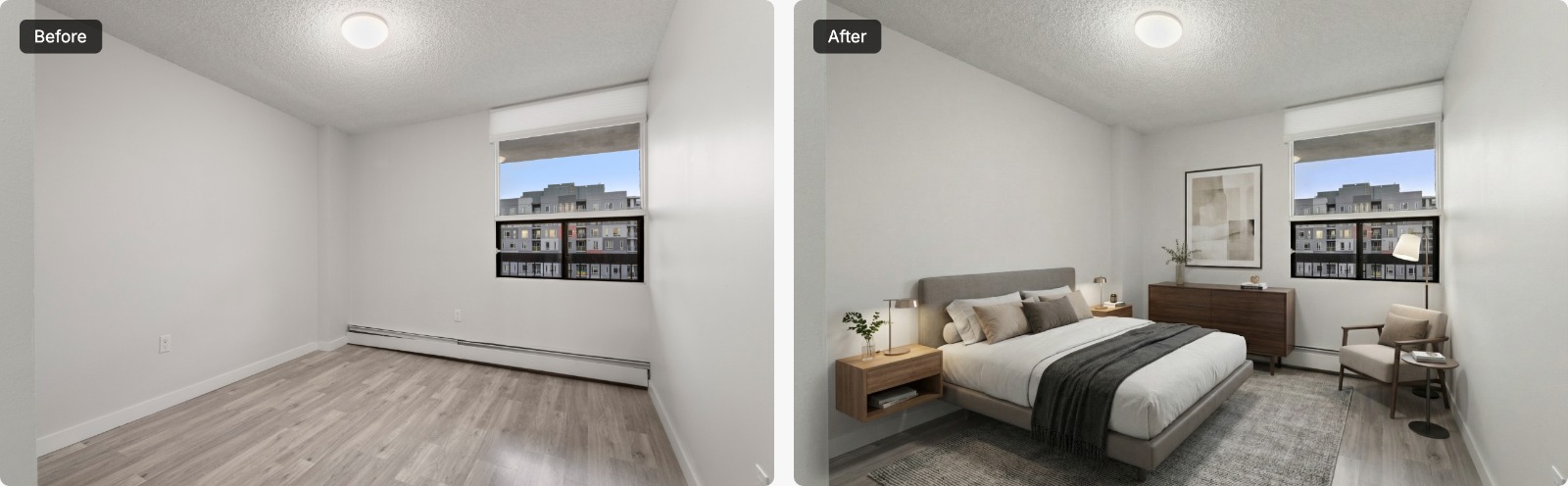
The fundamental principle is simple: virtually stage every room that will appear in your listing photos. Since virtual staging costs a fraction of traditional staging (from about $1 per photo with AI, versus thousands for physical furniture), the cost of leaving rooms unstaged rarely justifies the savings.
Minimum viable staging (budget constrained):
- 3-4 rooms: Living room, primary bedroom, kitchen, dining room
- Cost: about $4–$8 with AI staging, or roughly $75–$300 with human-designed virtual staging
Recommended staging (most properties):
- 6-10 rooms: All main living spaces plus secondary bedrooms
- Cost: about $6–$20 with AI staging, or roughly $150–$750 human-designed
Comprehensive staging (competitive markets):
- Every photographed room including bonus spaces and outdoor areas
- Cost: about $10–$40 with AI staging, or roughly $250–$1,500 human-designed
But the real question isn't just "how many"; it's "which ones create the biggest impact?" Agents have a clear view on this: in NAR's 2025 Profile of Home Staging, buyers' agents named the living room (37%), primary bedroom (34%), and kitchen (23%) as the most important rooms to stage. Let's examine room priority in detail.
The High-Impact Rooms: Stage These First
1. Living Room (Priority: CRITICAL)
Why it's essential:
The living room is often the first interior photo buyers see after the exterior shot. It sets the tone for the entire home and signals whether this property deserves continued attention or should be scrolled past.
Living rooms face unique visualization challenges when empty:
- Large, awkward spaces that buyers struggle to furnish mentally
- Lack of focal points (fireplace, windows, architecture get lost without furniture anchors)
- Appears cold and institutional rather than inviting
- Room size is difficult to gauge without furniture for scale
Staging impact:
A well-staged living room transforms buyer perception instantly. A sectional sofa defines the conversation area, a coffee table provides scale reference, area rugs anchor the space, and accessories (throw pillows, artwork, plants) create warmth.
What to include in living room staging:
- Primary seating (sofa or sectional)
- Accent chairs or loveseat
- Coffee table
- End tables with lamps
- Area rug
- Artwork above sofa or mantel
- Plants or greenery
- Throw pillows and blankets
Priority: 10/10 - Never skip the living room
2. Primary Bedroom (Priority: CRITICAL)
Why it's essential:
The primary bedroom is the second most important room in any home. Buyers spend significant time evaluating this space because it's their personal sanctuary, where they'll start and end every day.
Empty primary bedrooms create specific buyer concerns:
- "Will our king bed fit?"
- "Is there room for nightstands and a dresser?"
- "Where would the TV go?"
- "This feels small and depressing"
Staging impact:
A staged primary bedroom answers every question while creating aspirational appeal. Buyers see proof that furniture fits comfortably, imagine themselves in the beautiful bedding, and emotionally connect with the lifestyle the room represents.
What to include in primary bedroom staging:
- Bed (appropriately sized for room - king, queen, or full)
- Nightstands (two) with lamps
- Dresser or chest of drawers
- Bench at foot of bed (if space allows)
- Area rug
- Artwork above bed
- Bedding, pillows, throw blanket
- Decorative accessories
Priority: 10/10 - Equally critical as living room
3. Kitchen (Priority: HIGH)
Why it's important:
Kitchens sell homes. Even though kitchens are never "empty" (cabinets and appliances remain), staging the countertops, table, and island creates warmth and lifestyle appeal.
Unstaged kitchens look sterile and unused. Staged kitchens look like someone actually cooks, eats, and lives there.
Staging impact:
Kitchen staging is subtle but powerful. Virtual staging can add:
- Countertop styling (coffee maker, fruit bowl, cookbooks)
- Table and chairs in eat-in kitchens
- Island bar stools
- Window treatments
- Pendant lighting enhancement
- Fresh flowers or plants
What to include in kitchen staging:
- Dining table and chairs (if eat-in kitchen)
- Bar stools at island
- Countertop accessories (fruit bowl, coffee station, cutting board)
- Small appliances (toaster, coffee maker - if complementary to style)
- Fresh flowers or herb pots
- Decorative dish towels
Priority: 9/10 - High impact, especially for home buyers who prioritize cooking and gathering
4. Dining Room (Priority: HIGH)
Why it's important:
Formal dining rooms are increasingly being converted to offices, playrooms, or other uses, but when a home has a designated dining space, staging it properly prevents buyers from dismissing it as "wasted space."
Empty dining rooms look like dead zones, just a big empty box that serves no purpose. Staged dining rooms demonstrate functionality and entertaining potential.
Staging impact:
A dining table set for dinner creates immediate purpose. Buyers visualize holiday meals, dinner parties, and family gatherings. The room transitions from "useless formal space" to "valuable entertaining area."
What to include in dining room staging:
- Dining table (sized appropriately for room)
- Chairs (6-8 for most rooms)
- Centerpiece (flowers, candles, or decorative bowl)
- Table setting (placemats, dishes, glassware - optional)
- Buffet or sideboard
- Artwork
- Area rug
- Lighting fixture enhancement
Priority: 8/10 - Essential for homes with formal dining rooms
5. Home Office (Priority: HIGH in 2026)
Why it's critical in 2026:
Remote and hybrid work have made a dedicated workspace a priority for many buyers. Showing that a spare room or nook can work as an office helps buyers who need one picture it immediately.
Unstaged office spaces look like spare bedrooms or undefined rooms. Buyers wonder, "Could I fit a desk in here?" Staged offices answer definitively: "Yes, and here's exactly how it works."
Staging impact:
Office staging shows buyers this home supports their lifestyle. The desk placement demonstrates the room works for work-from-home needs, bookcases show storage capacity, and professional styling suggests productivity and organization.
What to include in home office staging:
- Desk (appropriately sized)
- Office chair
- Bookshelf or storage
- Desk lamp
- Laptop or computer (optional)
- Decorative items (books, plants, artwork)
- Area rug
Priority: 9/10 - Especially valuable where many buyers work from home
The Medium-Impact Rooms: Stage These for Competitive Edge
6. Secondary Bedrooms (Priority: MEDIUM-HIGH)
Why they matter:
While not as critical as the primary bedroom, secondary bedrooms need staging to:
- Demonstrate room sizes
- Show versatility (bedroom, office, nursery, gym)
- Prove the home accommodates families, guests, or hobbies
- Prevent all bedrooms from looking identical
Staging strategy for secondary bedrooms:
Stage each bedroom differently to show versatility:
- Bedroom 2: Guest room with queen bed
- Bedroom 3: Kids' room or nursery
- Bedroom 4: Teen room or craft room
This variety demonstrates the home works for different life stages and needs.
What to include in secondary bedroom staging:
- Bed (twin, full, or queen depending on room size)
- Nightstand with lamp
- Dresser or storage
- Desk (for kids' room or teen room)
- Age-appropriate decorative elements
- Area rug
Priority: 7/10 - Important for showing home functionality, but less impactful than primary spaces
7. Bonus Rooms/Flex Spaces (Priority: MEDIUM)
Why they matter:
Bonus rooms, lofts, and flex spaces are selling features, but only when buyers can envision their purpose. Empty bonus rooms look like expensive wasted square footage.
Common bonus room functions to stage:
- Media room / home theater
- Playroom
- Home gym
- Craft room / hobby space
- Reading nook / library
- Game room
Staging impact:
Staging bonus rooms as specific functional spaces adds perceived value. A staged home gym suggests, "You don't need an expensive gym membership." A staged playroom tells families, "This home has room for your kids' stuff."
What to include in bonus room staging:
Depends on function, but examples:
- Home gym: Exercise equipment, yoga mats, mirrors, motivational art
- Playroom: Toy storage, small table and chairs, colorful rug
- Media room: Sectional sofa, TV setup, theater seating
- Game room: Pool table, card table, bar area
Priority: 7/10 - Adds significant value by demonstrating usability of square footage
8. Primary Bathroom (Priority: MEDIUM)
Why it matters:
Bathrooms are never truly "empty" (fixtures remain), but staging with towels, accessories, and styling creates a spa-like feel that elevates the space.
Staging impact:
Virtual staging can add:
- Luxury towels on towel bars
- Decorative tray with accessories on counter
- Plants or flowers
- Artwork
- Bathmat or rug
- Candles (for spa atmosphere)
Priority: 6/10 - Nice enhancement but not critical; prioritize if the bathroom is a standout feature
The Lower-Impact Rooms: Stage If Budget Allows
9. Additional Bathrooms (Priority: LOW-MEDIUM)
Secondary bathrooms benefit from styling but aren't make-or-break spaces. If budget is tight, these can be photographed unstaged.
When to stage secondary bathrooms:
- Luxury properties where every detail matters
- Unique or high-end bathrooms worth showcasing
- When you're already staging 10+ other rooms (marginal cost is minimal)
What to include:
- Towels
- Small decorative items
- Plants
Priority: 4/10 - Low priority unless bathroom is exceptional
10. Laundry Rooms (Priority: LOW)
Laundry rooms are functional spaces that don't require extensive staging. If photographed, simple styling suffices:
- Baskets
- Detergent bottles
- Folded towels
Priority: 3/10 - Very low priority
11. Mudrooms/Entryways (Priority: LOW-MEDIUM)
These transitional spaces benefit from organizational staging:
- Bench with storage
- Hooks with coats/bags
- Shoe storage
- Baskets or bins
Priority: 5/10 - Shows organization potential but not critical
12. Outdoor Spaces (Priority: MEDIUM-HIGH depending on market)
Patios, decks, balconies, and backyards are increasingly important selling features. In markets with good weather or where outdoor living is valued, staging these spaces is essential.
When outdoor staging is critical:
- Properties in warm climates (California, Florida, Texas, Arizona)
- Homes with exceptional outdoor features (pool, views, large decks)
- Urban properties where outdoor space is rare/valuable
- Luxury properties where lifestyle amenities matter
What to include in outdoor staging:
- Patio furniture (dining set or lounge seating)
- Grill or outdoor kitchen accessories
- Planters with greenery
- Outdoor lighting
- Fire pit or fireplace accessories
- Pool furniture (if applicable)
Priority: 8/10 in warm climates, 5/10 in cold climates
Strategic Staging by Property Type
Studio and 1-Bedroom Condos/Apartments
Recommended staging: 3-5 rooms
- Living area (CRITICAL)
- Bedroom (CRITICAL)
- Kitchen styling (HIGH)
- Balcony/patio if applicable (MEDIUM-HIGH)
- Bathroom (OPTIONAL)
Budget range: about $3–$10 with AI, or $75–$375 human-designed
Why this works: Small properties have fewer rooms to stage, making comprehensive staging affordable
2-Bedroom Condos/Townhomes
Recommended staging: 5-7 rooms
- Living room (CRITICAL)
- Primary bedroom (CRITICAL)
- Second bedroom (HIGH - stage as office for maximum appeal)
- Kitchen styling (HIGH)
- Dining area (MEDIUM-HIGH)
- Outdoor space (MEDIUM-HIGH)
- Primary bathroom (OPTIONAL)
Budget range: about $5–$14 with AI, or $125–$525 human-designed
Why this works: Shows versatility while hitting all high-impact spaces
3-Bedroom Single Family Homes
Recommended staging: 7-10 rooms
- Living room (CRITICAL)
- Primary bedroom (CRITICAL)
- Kitchen styling (HIGH)
- Dining room (HIGH)
- Home office/Bedroom 2 (HIGH)
- Kids room/Bedroom 3 (MEDIUM-HIGH)
- Family room if separate from living room (MEDIUM-HIGH)
- Outdoor patio/deck (MEDIUM-HIGH)
- Primary bathroom (OPTIONAL)
- Secondary bathroom (OPTIONAL)
Budget range: about $7–$20 with AI, or $175–$750 human-designed
Why this works: Shows how every bedroom and living space can be used
4+ Bedroom Large Homes
Recommended staging: 10-15 rooms
- All main living spaces (living, dining, kitchen) (CRITICAL)
- Primary suite (bedroom + bathroom) (CRITICAL)
- Home office (HIGH)
- All secondary bedrooms (staged with different purposes) (MEDIUM-HIGH)
- Bonus room/loft (HIGH)
- Family room (HIGH)
- Outdoor spaces (HIGH)
- Flex spaces (MEDIUM)
- Additional bathrooms (OPTIONAL)
Budget range: about $10–$30 with AI, or $250–$1,125 human-designed
Why this works: Large homes need comprehensive staging to show all square footage has purpose
Luxury Properties ($1M+)
Recommended staging: 15+ rooms including all photographed spaces
- Every main living area (CRITICAL)
- All bedrooms (HIGH)
- Primary bathroom and powder rooms (MEDIUM-HIGH)
- All specialty rooms (wine cellar, gym, theater, etc.) (HIGH)
- Outdoor spaces including pool areas (CRITICAL)
- Guest house if applicable (HIGH)
Budget range: premium human-designed virtual staging often runs $500–$3,000+; many luxury listings also use traditional staging for key rooms
Why this works: Luxury buyers expect perfection in presentation; incomplete staging suggests lack of attention to detail
What It Costs to Stage More Rooms
Your cost depends far more on how you stage than on how many rooms you choose:
- AI virtual staging: roughly $1–$2 per photo. Staging 10 rooms costs about $10–$20, so room count is rarely a budget question at all.
- Human-designed virtual staging: typically $25–$75 per photo, with premium and luxury services charging more. Here, choosing rooms carefully matters.
- Traditional physical staging: usually priced as a package plus monthly rental, often running into the thousands. Most sellers stage only the main living areas this way.
A practical approach for most listings: use AI staging for every photographed room, and if the property calls for it, invest in human-designed or physical staging for the one or two rooms that matter most. Our full cost breakdown compares the options in detail.
The Room Staging Priority Framework
Use this decision tree to determine which rooms to stage when budget is limited:
Tier 1: Never Skip These (Stage Even on Minimal Budget)
1. Living room
2. Primary bedroom
These two rooms alone can transform a listing. If you can only afford to stage 2 rooms, these are the ones.
Tier 2: Add These for Competitive Presentation
3. Kitchen (styling/table)
4. Dining room OR home office (whichever applies to your home)
5. One secondary bedroom
Staging through Tier 2 gives you 5-6 rooms, sufficient for most mid-market properties.
Tier 3: Add for Comprehensive Staging
6. Remaining secondary bedrooms
7. Family room (if separate from living room)
8. Primary bathroom
9. Outdoor spaces
Staging through Tier 3 covers 10-12 rooms, suitable for larger homes and competitive markets.
Tier 4: Add for Luxury or Complete Presentation
10. Bonus rooms/specialty spaces
11. Secondary bathrooms
12. Mudroom/laundry
13. Additional outdoor areas
14. Guest house/casita
Complete staging including Tier 4 ensures no photographed space appears empty.
Common Staging Mistakes by Room Count
Mistake 1: Staging Only One Room
The problem: Staging only the living room creates jarring inconsistency. Buyers see one beautiful room, then navigate to empty bedroom photos and wonder why the staging stopped.
Better approach: Stage at least the living room AND primary bedroom. With AI staging, that's a few dollars in total, and the consistency is worth far more.
Mistake 2: Staging Every Bedroom Identically
The problem: All bedrooms staged as generic bedrooms with similar beds and décor looks lazy and doesn't demonstrate the home's versatility.
Better approach: Stage each bedroom with different purposes:
- Primary: Luxurious primary suite
- Bedroom 2: Professional home office
- Bedroom 3: Kids' room or nursery
- Bedroom 4: Guest room or teen space
Mistake 3: Ignoring the Kitchen
The problem: Kitchens are never empty (appliances and cabinets remain), so sellers skip staging them. But unstaged kitchens look sterile and unused.
Better approach: Even minimal kitchen staging (table and chairs, countertop styling) adds warmth and livability, and with AI staging it costs a dollar or two.
Mistake 4: Over-Staging Small Spaces
The problem: Staging a small 8x10 bedroom with a king bed, two nightstands, dresser, and desk makes the room look impossibly cramped and triggers buyer concerns about actual room size.
Better approach: Use appropriately sized furniture. Small bedrooms should show a full or queen bed with minimal additional pieces, proving the room is functional without being crowded. (Scale is one of the most common virtual staging mistakes.)
Mistake 5: Under-Staging Large Rooms
The problem: Placing only a sofa and coffee table in a massive 20x25 living room makes the room feel oddly sparse and doesn't demonstrate its full potential.
Better approach: Large rooms need substantial staging: sectional sofa, multiple accent chairs, coffee table, side tables, floor lamps, area rugs, and accessories. Show the room can handle furniture at scale.
Mistake 6: Skipping Outdoor Spaces in Warm Climates
The problem: In markets where outdoor living is a major selling point (California, Florida, Arizona), leaving patios and backyards empty wastes significant perceived value.
Better approach: In warm climates, outdoor staging is high-priority. Show seating, dining, and greenery so buyers can see how the space is used.
How Many Rooms Do Competitors Stage?
Staging norms vary a lot by market and price point, so the best benchmark is your own local competition. Before you decide:
- Pull up active listings in your price range and neighborhood on Zillow, Realtor.com, or your MLS.
- Count how many are staged (physically or virtually) and how many rooms each one shows furnished.
- Note which listings get attention: the ones going under contract quickly, or with the most saves and views.
Key insight: Aim to match or slightly exceed the presentation standard for your price point. In higher-end markets, buyers often expect every photographed room to be staged, and some luxury listings use physical staging as well.
Room-by-Room Priority Ranking
Combining the NAR room rankings above with how buyers typically browse listings, here's our suggested priority order for staging by room:
Highest Priority (Stage These First):
1. Living room - 10/10
2. Primary bedroom - 10/10
3. Home office - 9/10
4. Kitchen staging - 9/10
High Priority (Stage for Competitive Edge):
5. Dining room - 8/10
6. Outdoor spaces (in warm climates) - 8/10
7. Secondary bedrooms - 7/10
8. Bonus rooms/flex spaces - 7/10
Medium Priority (Stage If Budget Allows):
9. Primary bathroom - 6/10
10. Outdoor spaces (in cold climates) - 5/10
11. Mudroom/entryway - 5/10
Lower Priority (Stage for Comprehensive Presentation):
12. Secondary bathrooms - 4/10
13. Laundry rooms - 3/10
14. Utility spaces - 2/10
The takeaway: the top four or five rooms carry most of the impact. With AI staging, though, staging everything else costs so little that there's rarely a reason to stop there.
The Ideal Room Count by Situation
Situation 1: "We need to sell quickly in a competitive market"
Recommended staging: 10-15 rooms (comprehensive)
Investment: about $10–$30 with AI, more with human-designed staging
Why: Complete staging ensures your listing stands out in crowded markets where buyers have many options
Situation 2: "We're on a tight budget but want to compete"
Recommended staging: 5-7 rooms (strategic)
Investment: about $5–$14 with AI staging
Why: Focus on the highest-impact rooms; with AI staging you can usually afford to add the rest too
Situation 3: "Our home is unique/luxury and needs premium presentation"
Recommended staging: All photographed rooms + traditional staging for key spaces
Investment: varies widely; premium virtual staging plus traditional staging for key rooms can run into five figures
Why: Luxury buyers expect exceptional presentation throughout
Situation 4: "We're testing the market and might rent instead"
Recommended staging: 3-4 rooms (minimal)
Investment: a few dollars with AI staging
Why: Minimal investment to improve presentation while keeping options open
Situation 5: "We're investors flipping multiple properties"
Recommended staging: 6-10 rooms per property using AI staging
Investment: about $6–$20 per property, less with larger credit packs
Why: At roughly a dollar per photo, staging every flip is easily worth it
Making Your Decision: A Simple Framework
Step 1: Decide how you'll stage
- AI virtual staging: about $1–$2 per photo
- Human-designed virtual staging: about $25–$75+ per photo
- Traditional staging: a package plus monthly rental
Step 2: Count your photographable rooms
(Exclude closets, hallways, small utility spaces)
Step 3: Identify critical rooms from Tier 1-2
- Living room (CRITICAL)
- Primary bedroom (CRITICAL)
- Kitchen (HIGH)
- Dining room OR office (HIGH)
Step 4: Add rooms based on budget until you run out of money or rooms
Step 5: Ensure consistency
- If staging 5+ rooms, make sure main living floor is completely staged
- Don't leave obvious gaps (staging living room but not adjacent dining room looks odd)
- Stage bedrooms in order of size/importance
The Final Answer: How Many Rooms?
For most properties, staging 7-10 rooms hits the sweet spot between budget efficiency and competitive presentation. This typically includes:
- Living room ✓
- Primary bedroom ✓
- Kitchen styling ✓
- Dining room ✓
- Home office ✓
- 2 secondary bedrooms ✓
- Primary bathroom ✓
- Outdoor space ✓
- Bonus room ✓
Total investment: about $9–$18 with AI staging, or roughly $225–$675 human-designed
This provides comprehensive staging without unnecessary spending on low-impact spaces like laundry rooms or secondary bathrooms.
The exceptions:
- Small properties (studios, 1BR): Stage everything (3-5 rooms)
- Budget constraints: Stage 3-4 critical rooms minimum
- Luxury properties: Stage all photographed rooms, and consider traditional staging for key spaces
- Competitive markets: Stage more to stand out
- Soft markets: Stage strategically (high-impact rooms only)
Remember: virtual staging costs so little relative to potential sale price impact that the question is rarely "can I afford to stage more rooms?" but rather "can I afford not to?"
Every additional staged room helps buyers understand more of the home. With AI staging, the cost of one more room (a dollar or two) is negligible compared to the cost of one extra week on market (mortgage, utilities, opportunity cost). For the best results, start with good photos; here's how to photograph empty rooms.
When in doubt, stage one more room. Your future self, closing on a great offer, will thank you.